What do you know about pensions?
A pension fund is essentially long-term savings for the future. When you start working, a portion of your salary goes into a pension fund that accumulates over the course of your career.

Frjálsi is the largest private pension fund in the country and the majority of assets are the private savings of fund members.
Frjálsi differs from most other pension funds in that members are offered the option to allocate the majority of their mandatory savings into inheritable private savings.
Frjálsi Pension Fund is a fully licensed pension fund that was established in 1978.
A pension fund is essentially long-term savings for the future. When you start working, a portion of your salary goes into a pension fund that accumulates over the course of your career.
Although your retirement years may seem far away, pension savings represent one of the most important financial decisions you will make.
By contributing to a pension fund, you are building up future income while also gaining important insurance protection during your working years.
If you lose your ability to work due to illness or an accident, the pension fund can provide you with financial support. In addition, you can build up private pension savings that will benefit you later in life.
The sooner you start saving, the more time your savings have to grow and generate returns.

You can start making supplementary savings with Frjálsi. By doing so, you will receive a 2% salary increase in the form of a matching contribution from your employer.
Supplementary savings are fully inheritable and can be used tax-free to help you buy a home.
Frjálsi places great importance on providing excellent service to its pension fund members. You can keep track of your pension savings at any time in the Arion app and carry out all the main actions.
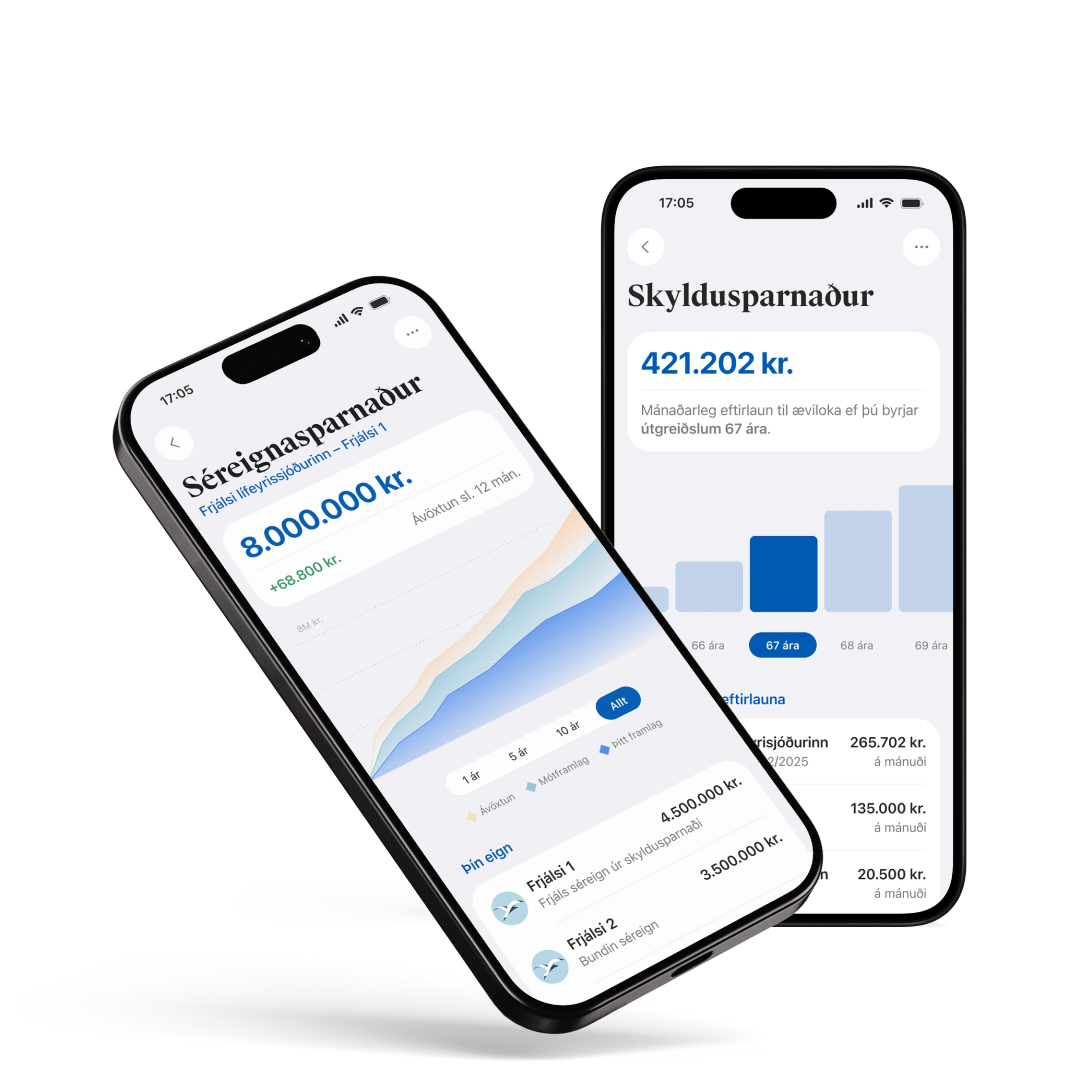
Frjálsi differs from most other pension funds in that members are offered the option to allocate the majority of their mandatory savings into inheritable individual savings, which increases flexibility when it comes to payouts.
At Frjálsi, you have a choice. For example, you choose your mandatory savings plan based on what proportion of co-insurance and private pension savings you feel suits you best.
Pension savings are long-term savings, and Frjálsi's long-term returns are strong.
Members of Frjálsi pension fund have the option to take out loans secured against residential property.
At Frjálsi, you can allocate the majority of your mandatory savings into inheritable private savings that are passed on upon death.
You can elect board members, but the board of the pension fund consists only of fund members. Your opinion matters.
You choose an investment path for your savings or a lifeline option, so that your savings are automatically transferred between paths based on age, thereby taking on less risk as we get older.
Benefit accrual is age-related, which means that contributions paid at a younger age provide greater benefits than those paid later, as they accumulate interest over a longer period of time.
When making investment decisions, emphasis is placed on responsible investments.
Freedom Path
Maximum flexibility
44%
Open private pension is available for withdrawal from the age of 60 and is fully inheritable. .
56%
56% Co-insurance provides you with a retirement pension from the age of 60 until the end of life, along with entitlement to disability, spouse, and child pension.
Inheritance Path
Highest inheritable ratio
34%
Open private pension is available for withdrawal from the age of 60 and is fully inheritable.
42%
Restricted private pension is available for monthly payments from the age of 60 to the age of 82 and is fully inheritable.
24%
Co-insurance provides you with an old-age pension from the age of 82 until the end of life, along with the right to disability, spouse, and child pension.
All employees between the ages of 16 and 70 pay into a pension fund as required by law in the country. This ensures us lifelong retirement benefits during our retirement years and pension payments in the event of unforeseen circumstances, such as disability, spouse’s, and child’s pensions.
All employees between the ages of 16 and 70 pay 4% of their wages into a pension fund, and the employer contributes 11.5% in return. Generally, the employer is responsible for submitting the payments to the pension fund, so the employee does not need to worry about it. Your employment contract and collective agreement will specify which pension fund you are required to contribute to. Some people can choose their own pension fund and should choose carefully, as the structure of funds varies.
The premium paid into a pension fund amounts to at least 15.5% of wages, divided into a 4% contribution from the employee and an 11.5% contribution from the employer. Contributions are tax-deductible from taxable income, meaning lower taxes are paid than would otherwise be the case. In other words, the contributions are deducted from wages before income tax is calculated. However, when pension payments from the pension funds begin, the payments are taxed as earned income. Pension payments are determined by contribution payments made throughout one's working life.
Co-insurance means that fund members guarantee each other pensions and disability and death benefits. This ensures us lifelong retirement pensions during our retirement years and pension payments in the event of unforeseen circumstances, such as disability, spouse’s, and child's pensions.
Disability and survivor’s pension is a collective term for disability, spouse’s, and child's pension. Subject to certain conditions, a fund member may receive a disability pension if they suffer a loss of working capacity, as well as a child's pension due to disability. Upon the death of a fund member, their spouse receives a spouse's pension and their children receive a child's pension until the age of 18, provided certain conditions are met. It takes three years to acquire so-called projected rights, which are rights that would have been accrued had the fund member continued making contributions to the fund.
By paying into a pension fund, we acquire rights. These are rights to retirement, disability, spouse’s, and child’s pension. The extent of the rights you receive depends on how much you contribute to the fund over your working life and how well the fund manages to generate returns over a longer period of time. In addition, demographic factors have an influence, which include, among other things, the gender composition and disability burden of the funds.
No, pension funds can vary greatly. Some funds have mandatory membership, meaning you may be required to contribute to a specific fund depending on your employment and collective agreements. The structure of funds differs as well. Some funds allocate the entire mandatory contribution to a co-insurance scheme, while others emphasize that a portion of the mandatory savings goes into a private pension account, which is inheritable and provides greater flexibility when it comes to payouts.
Private pension savings is one type of pension savings, it is inheritable and comes with flexibility in payouts. There are several types of private pension savings:
Supplementary pension savings
Voluntary private savings from mandatory contributions
Restricted private pension savings
Specified private pension savings
Inherited private pension savings
Supplementary savings represent one of the most best savings options available. You contribute 2 – 4% of your salary to the savings and your employer contributes 2% in return. This way, you effectively receive a 2% pay rise! You can withdraw your supplementary savings at the age of 60, but you can also use them tax free to help buy a home. Supplementary savings are a type of private pension savings and are therefore inheritable.
You can track the status of your pension savings at any time in the Arion app. You can also view a statement on My Pages of the fund for a selected period, and statements for an 18-month period are also published there twice a year. If you would like a paper statement sent to your home, you can request one on My Pages or by sending an email to frjalsi@frjalsi.is. It is important to keep a close eye on whether contributions have been received and are in line with your pay slips, in order to reduce the risk of valuable pension savings being lost. If contributions are in arrears, we encourage you to contact the fund without delay.