Responsible investments
The main role of Frjálsi Pension Fund is to invest members' contributions and provide members, their surviving spouses, and children with a lifelong pension.

Frjálsi is the largest private pension fund in the country and the majority of assets are the private savings of fund members.
Frjálsi differs from most other pension funds in that members are offered the option to allocate the majority of their mandatory savings into inheritable private savings.
Frjálsi Pension Fund is a fully licensed pension fund that was established in 1978.
The main role of Frjálsi Pension Fund is to invest members' contributions and provide members, their surviving spouses, and children with a lifelong pension.
Article 36 of the Pension Funds Act stipulates that the board of a pension fund shall formulate and publish an investment policy for the fund in accordance with the provisions of the Act. Since 2017, ethical criteria in investments have also been a statutory requirement. Frjálsi has placed considerable emphasis on this work, acquiring knowledge by drawing on the field of responsible investment and establishing a policy on the matter in 2018.
One of the factors that makes investment opportunities attractive to Frjálsi is that they meet the current needs of fund members without compromising the ability of future generations to meet their own needs.
The primary objective of the responsible investment philosophy is to promote positive environmental, social and governance (ESG) factors, reduce risk, and generate sustainable long-term returns. Investors are increasingly taking these factors into account when analyzing and evaluating investment opportunities.
Environmental criteria relate, among other things, to performance and supervision in climate and environmental matters, and to how the environmental impact of each individual investment is assessed and monitored.
Social criteria primarily focus on how employee matters are addressed, as well as the environment in which they work, such as equality within companies, general human rights, and safety.
Governance relates to, among other things, board diversity and structure, management and organization, suppliers, employee conditions, and measures against corruption and bribery.
The core principles guiding Frjálsi’s responsible investment approach are that the companies in which the fund holds ownership interests comply with the laws and regulations applicable to their operations. In addition, the fund has established its own responsible investment criteria based on the United Nations Global Compact principles on corporate social responsibility. Through this approach, the fund contributes to achieving the United Nations Sustainable Development Goals (SDGs).
Companies that Reitun does not audit but are included in the investment portfolio are assessed based on policies, reports related to corporate social responsibility and/or other relevant data. Regarding fund management companies, a questionnaire is sent out where the aim is for responses to cover their policies on responsible investments, such as whether companies are members of UN PRI, what benchmarks are considered in investments, and how the operator or fund approaches social responsibility in investments.
The main focus of the ESG assessment is on assets other than those in wind-down proceedings, government bonds/funds, member loans, and investment options such as derivative contracts associated with conventional financial instrument transactions.
Further information on the social responsibility of the fund's operator, Arion Bank, can be found here.
Part of the policy on responsible investments is the fund’s shareholder policy, which has been adopted by the Board of Directors. The policy defines the fund’s requirements regarding corporate governance in domestic listed companies in which it holds shares. It sets out when and how the fund intends to exercise its rights as a shareholder, the requirements it makes of the companies in which it invests, and how it seeks to promote greater transparency and a credible approach to its involvement with companies in which it holds an ownership interest.
Among the topics covered are:
Scope of application
Competition considerations
Selection of and requirements for board members
Communication with board members and executives
Remuneration
Each year, Frjálsi publishes information on its website detailing how the fund voted at shareholder meetings of the companies that fall within the scope of the policy.
Arion Bank's Asset Management division, on behalf of the fund, has taken further steps in analysing the fund's portfolio. Among other things, the carbon footprint of direct holdings in domestic listed companies has been assessed and the proportion of green investments in the fund's portfolio has been estimated.
The main greenhouse gas emissions of Frjálsi occur through the fund's investments and take place through ownership in companies, both directly and indirectly. The overview of the carbon footprint is currently limited to listed domestic companies, but in the future, the aim is to capture the carbon footprint of the portfolio even more comprehensively. The estimated net CO2 emissions attributable to the direct ownership share at year-end 2021 in domestic listed companies, based on figures provided by the companies for the year 2020, amounted to 1,441.2 tonnes, or 0.35 tonnes per every ISK 100 million in Frjálsi's total portfolio. A more detailed breakdown can be seen in the figure below.
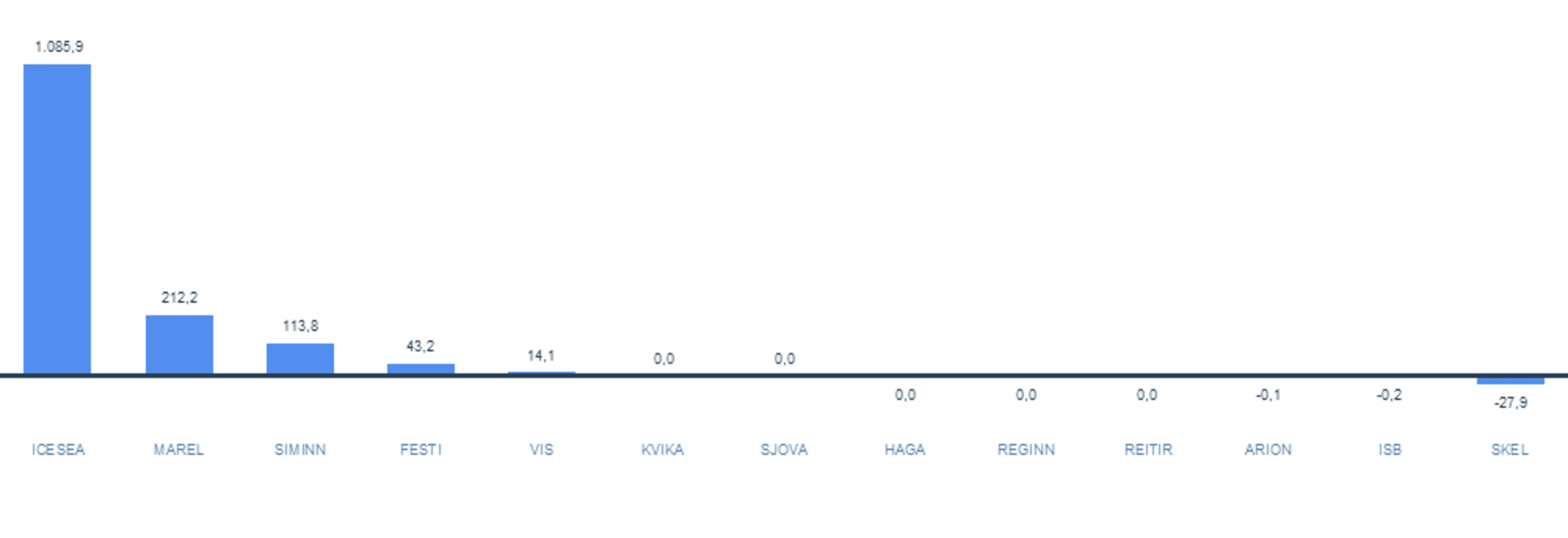
In 2021, pension funds joined forces on the classification of green assets following a declaration of intent towards the international organisation CIC. The table below shows the assets of Frjálsi that were classified as green investments at the end of 2021. The work on classifying Frjálsi's total asset portfolio is already well advanced and will continue until it is complete.
*CIC eligibility indicates what proportion of an asset’s market value qualifies toward the fund’s stated objective for green investments under the Climate Investment Challenge (CIC) initiative.
Frjálsi's policy on responsible investments is set with reference to the United Nations' core principles on corporate social responsibility.